martes, 8 de julio de 2014

Adverbs of frequency 

as the name implies, we used to know how often a subject or periodicity performs a certain action. 

To know when to use them, here a list of the most common frequency adverbs in English. The list is in order of frequency with which the action is performed: starting with "always" and ending with "never." 

Always (always) - the action is 100% of the time 

How frequently do you think of me? (How often do you think about me?) 
Always, I can not stop thinking of you. (Forever. can not stop thinking about you.) 
Frequently (often) 

How often do you practice sport? (How often do sport?) 
Frequently, because i love swimming. (Often because I love to swim.) 
Usually or Normally (usually or normally) 

Karen, do you know what time is John going to arrive? (Karen, do you know what time you will arrive Juan?) 
No, John Usually arrives late. (No, John usually comes later.) 
Often (often) 

Do you come here Often? (Do you come here often?) 
Not very Often, and you? (Not very often, do you?) 
Sometimes (sometimes) 

How frequently do you go out with your friends? (How often do you go out with your friends?) 
I sometimes just go out with them. (Only sometimes I go out with them.) 
Occasionally (rarely) 

Often Do you play chess? (Do you play chess often?) 
No, I occasionally play chess. (No. chess game occasionally.) 
Hardly ever Seldom or (rarely) 

Have you tried to speak to them? (Have you tried talking to them?) 
Yes, They are but seldom at the office When we call. (Yes, but rarely in the office when we called.) 
Rarely (rarely) 

Is it always This Cold in February? (Is it always this cold in February?) 
No, it rarely gets cold That this time of the year. (No. It is rarely so cold at this time of year.) 
Never (ever) 

Have you seen this film before? (Have you seen this movie before?) 
No, I have never seen it. (No, I've never seen.) 
Now that you know what the most common frequency adverbs in English are, here the rules of how you use them.
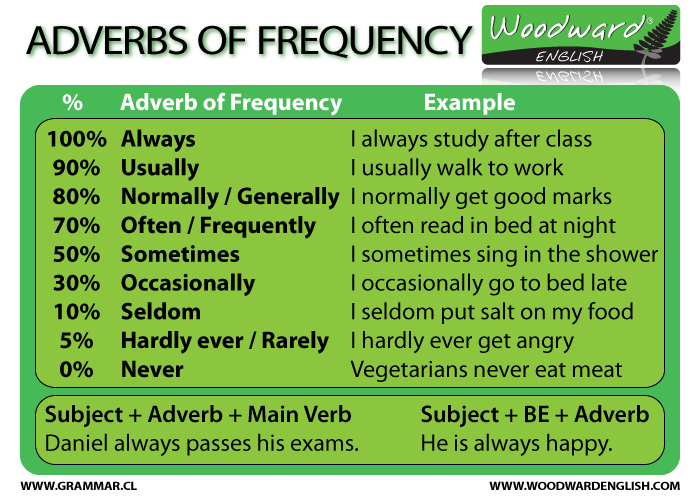

lunes, 7 de julio de 2014

past Progressive

The Past Progressive or past continuous in English is a tense, unlike the simple past is used to talk about the development of a particular action was happening at a given time. It is also used to express an action taking place when someone interrupted and also to refer to actions occurring simultaneously.

Using the Past Progressive in English?
The use of the past progressive in English can be summarized to the simple fact strictly follow its structure, which resembles the present progressive with the exception of the verb To Be is changed to the past tense "was" or "were":


When to use the Past Progressive?
There are three ways or three circumstances in which we can and should use the past progressive, these are:

     When we want to indicate an action that was happening in the past but was interrupted by another action. For example:

     When Laura arrived, I was reading the newspaper
     When Laura arrived, I was reading the newspaper

     OR

     I was reading the newspaper When Laura arrived
     I was reading the newspaper when Laura came

     When two or more actions occur together in the past. For example:

     Alex was reading while Mark was writing
     Alex was reading while Mark was writing

     OR

     While Mark was writing, Alex was reading
     While Mark was writing, Alex was reading

     When an action occurs at a specific time in the past. For example:
     What was I doing at ten o'clock This Morning?
     What was he doing at ten this morning Pundo?

     Linda was singing at eight o'clock last night
     Linda was singing at eight o'clock last night


Continuous or Present Progressive
 
The Present Continuous or Present Progressive tense is used to express actions happening at the same time they are talking, for example:
I am speaking Inglés. I'm speaking English. (It's happening now).
You are reading a book. You're reading a book.
I is studying the lesson. He is studying the lesson.
She is buying a hat. She is buying a hat.
It is raining. It's raining.
We are sleeping. We are sleeping.
You are dancing in the street. You are dancing in the street.
They are walking in the park. They are walking in the park.

This tense is constructed using the Present Simple as a subsidiary of the indicative mood of the verb TO BE as main verb in infinitive termination ING, as shown below:

In the table above uses the verb play (PLAY TO) exemplary.

It can also be used to refer to situations that happen around the time when we talk, but not exactly have to be at this very moment, for example:
I is working in a bank. He is working in a bank.
(It means it's his day job, but not necessarily the person should be working now).

miércoles, 2 de julio de 2014

preposisiones


   preposisiones 


La definición práctica: las preposiciones sirven de enlace entre palabras dentro de una oración. Dependiendo del sentido de la oración podemos utilizar preposiciones de tiempo, lugar, movimiento, etc.

Las preposiciones propias estan formadas por una sola palabra.

Las preposiciones impropias, normalmente son adjetivos, adverbios y participios que funcionan como preposición, y se forman de dos ó más palabras.


USO DE LAS PREPOSICIONES


Las preposiciones pueden realizar distintas funciones:

- Servir de enlace entre dos palabras o distintos elementos en la oración:

I'll see you at five o'clock / Te veré a las cinco

- Pueden acompañar a un verbo sirviendo de enlace a su complemento. En este caso, pueden no alterar el significado del verbo o alterarlo con lo que constituyen una palabra distinta.

To look / Mirar (no altera el significado del verbo)
To look after / Cuidar de (se altera el significado del verbo)

- Cuando ponemos un verbo después de una preposición, en inglés normalmente se utiliza la forma ' ing' y no el infinitivo.

You shouldn’t go to India without visiting the Taj Mahal.
 
No deberías ir a la India sin visitar el Taj Mahal.
I’m interested in studying psychology. / Estoy interesado en estudiar psicología.

Las principales preposiciones en inglés son:


about alrededor de, sobre above por encima de
after detrás de, después de among entre (tres o más)
at en, junto a before antes de, delante de
behind detrás de below debajo de
beneath debajo de beside junto a
between entre (dos o más) but excepto, pero
by por, junto a down hacia abajo
except excepto for para, por, durante, desde hace
from de, desde in en, dentro de
into en, adentro like como, igual a
near cerca de of de
off de (alejándose), fuera de on en, sobre
over por encima de, al otro lado since desde
through a través de throughout por todo
till = until hasta to a, hasta, hacia


preposiciones de tiempo

"I have dinner/ between 8 and 9. "(ceno entre las 8 y las 9)
- "My favorite time of the year/ is between the spring and the summer. " (mi temporada del año favorita/ es entre la primavera y el verano)
by - < br> Indica que en un momento determinado ya habrá pasado una acción.
Estructura: by + (tiempo
)
Ejemplos:
- "Tom /will be home/ by 10. " (Tom/ estará en casa/ a las 10)
- "By the time it rains/ we will all be home." (para cuando llueva/ todos ya estaremos en casa)
during - (durante)
Habña sobre un periodo de tiempo completo.
Estructura: during + (tiempo
)
Ejemplos:
- "Tom ate pizza/ during the football game. "(Tom comió pizza/ durante el partido de fútbol)
- "You can't use the phone/ during class" (no puedes usar en teléfono/ durante la clase)


     PREPOSICIONES DE LUGAR

inside (insáid) - dentro de, en

The children were playing inside the house.
Los niños estaban jugando dentro de la casa

outside (áutsáid) - afuera, fuera, fuera de

The dog sleeps outside the house.
El perro duerme afuera de la casa.

above (abáv) - encima de, sobre, arriba

We were flying above the clouds.
Estábamos volando por encima de la nubes.

below (bilóu) - debajo de

She has an apartment below mine.
Ella tiene un departamento debajo del mío